
Best feeder insects for crested geckos in 2026
Carolina Crickets
 Best Overall Banded crickets. Best for controlled feeding: small dubia roaches. Best calcium-focused alternative: black soldier fly larvae. This 2026 guide compares the best feeder insects for crested geckos by prey size, feeding behavior, preparation, and handling; Carolinacricketfarm fits crested gecko keepers seeking farm-raised crickets and dubia roaches.
- The best feeder insects for crested geckos complement a complete crested gecko diet; they do not replace it.
- Banded crickets are the default choice for keepers whose geckos respond to moving prey.
- Small dubia roaches suit controlled feeding, but a gecko must accept their slower movement.
- Black soldier fly larvae offer naturally higher calcium; mealworms belong in an occasional rotation.
- Carolinacricketfarm raises live crickets and dubia roaches for feeder-insect buyers.
Why this matters
Crested geckos need more than a container of insects. A complete diet formulated for crested geckos provides the nutritional foundation; live feeders add hunting opportunities and dietary variety when they fit that feeding plan. Do not turn a feeder-insect ranking into an insect-only diet.
The practical question is not which insect has the most impressive nutrition claim. It is which appropriately sized insect your gecko will eat, which you can prepare correctly, and which you can keep contained until feeding time.
For your 2026 feeding routine, choose the prey size before choosing the species. A small cricket is a better choice than an oversized roach, even when the roach ranks well for handling. Appetite also matters: an uneaten feeder contributes nothing to your gecko's diet.
What makes the best feeder insects for crested geckos?
Use these criteria to judge every option below:
- Appropriate size: Choose prey that your gecko can swallow comfortably. Keep insect width no greater than the space between the gecko's eyes as a conservative screening rule.
- Diet compatibility: Use insects alongside a complete crested gecko diet, not instead of it.
- Feeding response: Match active prey to a gecko that hunts; use contained prey when control matters more.
- Preparation: Consider gut-loading, hydration, and the supplementation your gecko's full care plan requires.
- Containment: Account for jumping, hiding, climbing, and your ability to remove leftovers.
- Actual acceptance: Prefer a feeder your gecko eats over a nutritionally appealing option it consistently ignores.
No single insect wins every category. The 2026 default below favors feeding response, while the alternatives solve specific handling or rotation needs.
Best feeder insects at a glance
| Rank | Feeder insect | Best for | Standout feature | Key limitation |
|---|---|---|---|---|
| 1 | Banded crickets | Movement-driven hunting | Active prey that encourages pursuit | Jumping and hiding complicate containment |
| 2 | Dubia roach nymphs | Controlled feeding | Easier to present in a smooth-sided feeding container | Some geckos ignore slower prey |
| 3 | Black soldier fly larvae | Calcium-focused rotation | Naturally calcium-rich compared with many common feeders | Low movement can limit interest |
| 4 | Acheta house crickets | Keepers maintaining an accepted house-cricket routine | Familiar active prey | Similar containment demands to other crickets |
| 5 | Mealworms | Occasional contained variety | Easy to present in a feeding dish | A poor default when softer, accepted prey is available |
Carolinacricketfarm supplies live crickets and dubia roaches. The cards below identify those feeder types; choose the appropriate insect size rather than assuming every size fits a crested gecko.


1. Banded crickets: best feeder insects for active hunting
Banded crickets are the default recommendation for a crested gecko that responds to moving prey. Their movement makes them conspicuous, and small crickets let you match the feeder to the animal rather than asking the gecko to manage oversized prey.
The advantage is behavioral, not a claim that banded crickets provide a complete diet. Prepare them properly, supervise feeding, and remove leftovers instead of releasing a batch into the enclosure.
Banded cricket pros:
- Active movement encourages a hunting response.
- Small individuals suit smaller geckos when selected carefully.
- Gut-loading lets you improve what the insect carries into the meal.
Banded cricket cons:
- Jumping makes transfers and containment harder.
- Uneaten crickets can hide and disturb the gecko.
- Nutritional preparation and supplementation still require attention.
Best for: Crested geckos that reliably pursue moving insects.
Verdict: Buy appropriately sized banded crickets when your gecko accepts them. Skip oversized individuals and do not leave loose crickets behind after feeding.
2. Dubia roach nymphs: best feeder insects for controlled feeding
Small dubia roach nymphs suit keepers who want to watch each feeding attempt. A suitable smooth-sided feeding container helps keep the prey in a defined area, making acceptance and leftovers easier to track.
Size selection is essential. An adult dubia roach is not interchangeable with a small nymph, and the species name alone tells you nothing about whether an individual fits your gecko.
Dubia roach pros:
- Nymphs are easier to contain than jumping crickets.
- Controlled presentation helps you confirm what was eaten.
- Gut-loading supports their use within an insect-feeding routine.
Dubia roach cons:
- Slower movement does not interest every crested gecko.
- Loose roaches can hide in substrate or furnishings.
- Larger individuals are unsuitable for smaller mouths.
Best for: Keepers prioritizing observation, containment, and deliberate prey presentation.
Carolinacricketfarm offers live dubia roaches, but supplier choice does not remove the need to select suitable prey. Match the insect to your gecko before feeding.
Verdict: Buy small dubia nymphs if your gecko accepts them. Do not build your routine around roaches that remain untouched.
3. Black soldier fly larvae: best feeder insects for calcium-focused rotation
Black soldier fly larvae have naturally higher calcium than many common feeder insects. That makes them a useful rotation option, not a substitute for reviewing the gecko's entire diet and supplementation plan.
Their restrained movement changes how you present them. Offer appropriately sized larvae where you can observe the feeding response rather than assuming a gecko accustomed to crickets will recognize them immediately.
Black soldier fly larva pros:
- Naturally calcium-rich relative to many common feeders.
- Small larvae provide an alternative prey form.
- Contained presentation makes uneaten larvae easier to identify.
Black soldier fly larva cons:
- Limited movement can reduce a gecko's interest.
- Acceptance differs between individual animals.
- Calcium content alone does not establish a complete feeding plan.
Best for: Keepers adding an accepted, calcium-rich insect to a varied routine.
Keep supplementation decisions connected to the complete food, other insects, and lighting your gecko receives. Do not automatically apply the same dusting routine to every feeder species.
Verdict: Hold until a small feeding trial confirms acceptance. Nutritional advantages only matter when the gecko actually eats the larvae.
4. Acheta house crickets: best for an established cricket-feeding routine
Acheta domesticus, commonly called the house cricket, is another active feeder option. If your gecko already eats appropriately sized house crickets, there is no need to switch solely because another cricket occupies the top position in this guide.
Acheta and banded crickets fill similar feeding roles. Alternating between them does not, by itself, establish a balanced diet or eliminate the need for gut-loading and suitable supplementation.
Acheta house cricket pros:
- Movement suits geckos that hunt active prey.
- An accepted feeder preserves a familiar feeding routine.
- Small individuals allow careful prey-size selection.
Acheta house cricket cons:
- Jumping and hiding make containment important.
- Loose leftovers can disturb the gecko.
- Switching cricket species does not solve broader diet problems.
Best for: Keepers whose crested geckos already accept house crickets reliably.
Judge the feeder by its condition, size, and your gecko's response. A familiar insect that receives proper preparation is more useful than a new insect offered without a feeding plan.
Verdict: Buy if Acheta house crickets already work for your gecko. Do not switch simply to follow a ranking.
5. Mealworms: best for occasional contained variety
Mealworms are easy to present in a suitable feeding dish. Their firm outer covering and less conspicuous movement make them a lower-priority choice for crested geckos than appropriately sized crickets or accepted dubia nymphs.
Mealworms are not automatically dangerous, and claiming that every mealworm causes impaction oversimplifies feeding risk. Prey size, hydration, animal health, and husbandry matter; mealworms still do not need to become your default insect.
Mealworm pros:
- Dish feeding makes leftovers easy to see.
- Individual worms are straightforward to present.
- Accepted worms add a different prey form to a rotation.
Mealworm cons:
- Less active movement can reduce feeding interest.
- Their firm outer covering makes them a less forgiving choice for tiny geckos.
- They are not a replacement for complete crested gecko food.
Best for: An occasional variety option for a healthy gecko that accepts appropriately sized worms.
Avoid escalating to larger worms just because the gecko ignores small ones. Lack of interest is not evidence that the prey needs to be bigger.
Verdict: Hold for occasional use. Skip mealworms as the default when your gecko already eats suitable crickets or dubia nymphs.
How the 2026 ranking works
This ranking prioritizes prey acceptance, suitable sizing, preparation, and containment. Banded crickets lead as a practical default for active hunters; dubia nymphs lead for controlled presentation; black soldier fly larvae serve a calcium-focused role.
Acheta house crickets remain useful for an established routine, while mealworms sit lower because they offer fewer reasons to replace accepted primary feeders. These are use-case recommendations, not results from a controlled feeding trial or a measured brand comparison.
Your gecko's feeding response outranks the list. A lower-ranked, appropriately sized feeder that gets eaten is more useful than a higher-ranked feeder that stays in the dish.
Prepare feeders before offering them
Choose size, prepare the insects, supervise the meal, and remove leftovers. This sequence matters more than switching suppliers or collecting more feeder species.
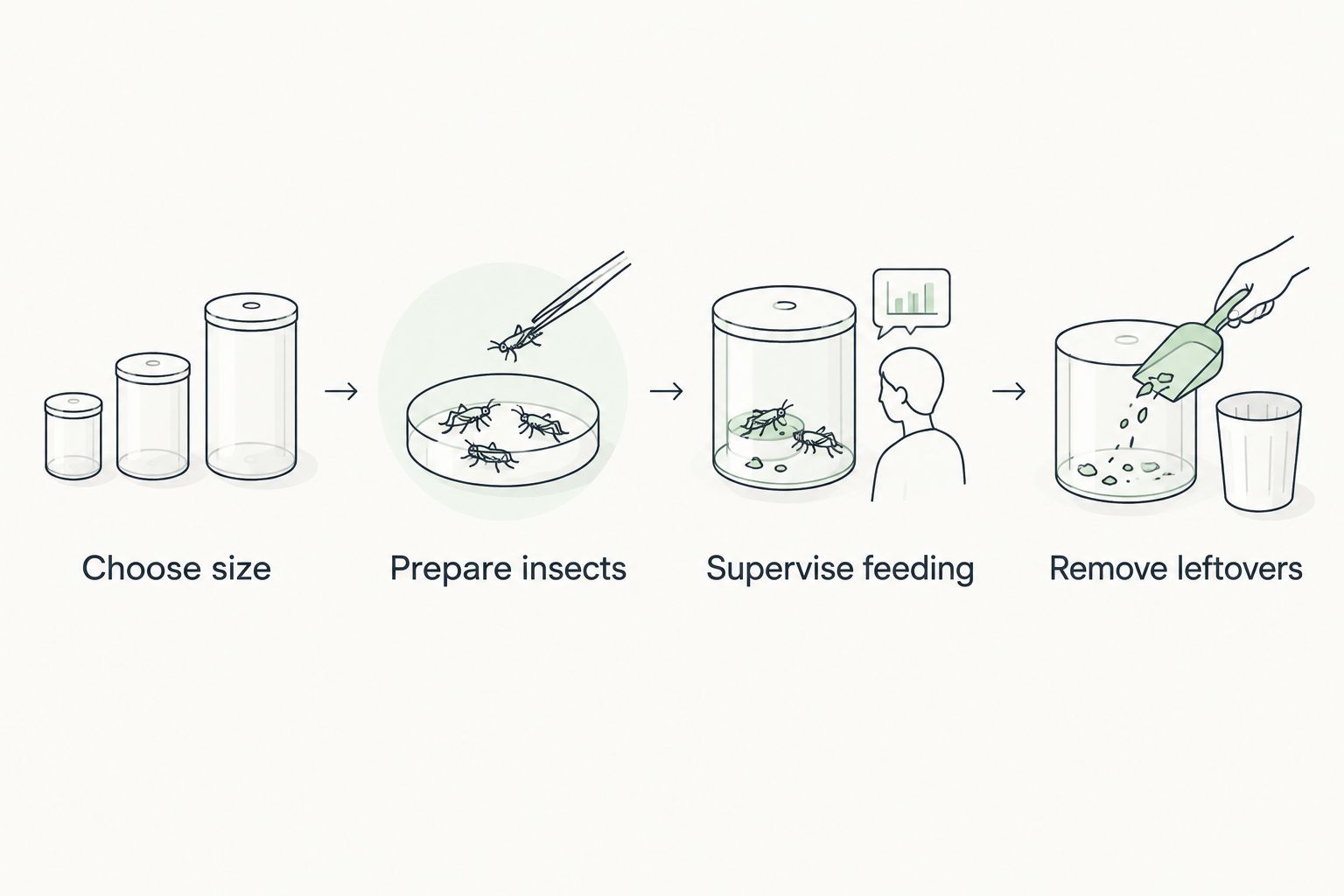
Choose size
Select feeders by body width, not just length or the seller's size label. Inspect the actual insect before feeding, especially when changing feeder species. Keep 1 feeder at a time in the presentation area during an acceptance trial so you can see the result clearly.
Prepare insects
Gut-load suitable feeders with a nutritious insect diet before offering them, and provide safe hydration in their holding container. Gut-loading and dusting do different jobs; neither turns insects into complete crested gecko food.
Match calcium and vitamin use to the complete diet and lighting plan. Ask a reptile veterinarian to resolve conflicting supplement instructions rather than stacking products without accounting for their contents.
Supervise feeding
Use 1 feeding station for a controlled trial, with a suitable dish or carefully handled feeding tool. Offer insects when your gecko is awake and responsive; do not chase the animal around the enclosure with prey.
Keep 1 feeding log recording the feeder type, prey size, and whether the gecko ate it. A simple record separates consistent acceptance from a single successful attempt.
Remove leftovers
Collect uneaten insects after the session. Do not leave crickets loose overnight, and do not assume a missing feeder was eaten if it could have hidden in the enclosure.
Persistent food refusal, weight loss, or a sudden change in behavior needs veterinary attention. Buying a different insect is not a treatment for illness.
Which feeder insects should you choose in 2026?
Start with appropriately sized banded crickets if your crested gecko hunts moving prey. Choose small dubia nymphs if controlled feeding matters more and your gecko accepts them. Add another insect only when it solves a real feeding need.
Black soldier fly larvae offer a calcium-focused alternative; Acheta house crickets preserve an accepted cricket routine; mealworms belong lower on the list as occasional variety. None replaces a complete crested gecko diet.
Carolinacricketfarm is a relevant feeder-insect source for keepers seeking farm-raised crickets or dubia roaches. The best purchase is the feeder type and size your animal eats—not the largest order or the longest species list.
FAQ
What's the best feeder insect for a crested gecko?
Appropriately sized banded crickets are the default choice for a crested gecko that hunts moving prey. Small dubia roach nymphs are a strong alternative when controlled presentation matters and the gecko accepts them.
Are dubia roaches better than crickets for crested geckos?
Dubia roach nymphs are better for controlled feeding, while crickets are better for conspicuous movement. Choose the appropriately sized insect your gecko actually eats rather than treating either species as universally better.
Can crested geckos eat mealworms?
Crested geckos can eat appropriately sized mealworms, but mealworms are an occasional option rather than the default recommendation. Their firm outer covering and restrained movement make suitable crickets or accepted dubia nymphs preferable starting choices.
Can a crested gecko live on feeder insects alone?
Feeder insects alone are not an appropriate complete diet for a crested gecko. Use a complete diet formulated for crested geckos as the nutritional foundation, with insects fitted into that feeding plan.
How big should feeder insects be for a crested gecko?
Choose insects no wider than the space between the crested gecko's eyes as a conservative screening rule. Inspect the actual prey rather than relying only on a size label, and select smaller individuals when uncertain.
Do feeder insects need calcium powder?
Calcium supplementation depends on the feeder species, complete diet, and lighting plan. Crickets and dubia roaches commonly require nutritional preparation, but naturally calcium-rich larvae should not automatically receive an identical dusting routine.
Can I leave crickets in my crested gecko's tank overnight?
Remove uneaten crickets instead of leaving them loose overnight. Crickets can hide and disturb the gecko, making both intake and enclosure cleanup harder to track.
Why won't my crested gecko eat dubia roaches?
A crested gecko can ignore dubia roaches because their movement does not trigger the same response as crickets. Confirm suitable prey size and controlled presentation; persistent refusal with weight loss or other changes requires a reptile veterinarian.
One last thing
An empty feeding dish does not always prove that your gecko ate. Insects can escape, hide beneath furnishings, or disappear into substrate.
For your next 2026 feeding trial, watch the actual capture and swallowing before adding more prey. That observation tells you more about acceptance than a species ranking does—and prevents an escaped insect from becoming a misleading entry in your feeding log.