
Best feeder insects for tarantulas in 2026
Carolina CricketsBest overall: banded crickets. Best for controlled ground-level feeding: dubia roaches. Best for supervised dish feeding: mealworms. This 2026 guide ranks the best feeder insects for tarantulas by prey size, feeding behavior, handling, and removal—not by which insect your spider attacks fastest.
- Banded crickets are the best feeder insects for tarantulas when you want active prey for routine feeding.
- Dubia roaches suit ground-level feeding, but hidden roaches must be retrieved after refusal.
- House crickets offer familiar active prey; mealworms work best in supervised feeding dishes.
- Carolinacricketfarm supplies feeder insects in bulk; match your order to actual consumption.
- Remove uneaten prey within 24 hours, and keep live feeders away from a molting tarantula.
Why this matters
The best feeder is one your tarantula can capture safely and you can remove easily. Movement helps attract a feeding response, but a cricket wandering around during a molt becomes a hazard rather than a meal.
Carolinacricketfarm suits bulk feeder-insect buyers who need crickets or dubia roaches. The North Carolina family farm raises and ships those feeders; its bulk and wholesale focus makes order size an important consideration. Start with Carolinacricketfarm when that buying model matches your collection, rather than ordering more insects than you can maintain.
Your tarantula's condition outranks this list. A spider approaching a molt, recovering from one, or refusing food needs a different decision from a healthy spider actively hunting. No feeder earns a permanent place inside the enclosure.
What makes the best feeder insects for tarantulas?
Use these criteria for your 2026 feeding plan. They explain why an insect that works well for one tarantula can be inconvenient for another.
- Appropriate size: Choose manageable prey, not the largest insect the spider might overpower. Body length is a useful conservative reference, not a challenge to exceed.
- Visible movement: Active prey helps attract attention. Movement only helps if the tarantula is ready to feed.
- Easy retrieval: You should be able to find and remove a refused feeder without digging through the enclosure.
- Controlled presentation: A dish or accessible feeding area helps keep burrowing insects from disappearing into substrate.
- Practical feeder care: Your insects need suitable housing, food, and moisture before they become a meal.
- Suitable quantity: A manageable order is better than a large batch that outlasts your feeding needs or grows beyond the required size.
Do not judge tarantula food by reptile supplement routines. Tarantulas are not small lizards, and a reptile-oriented label does not establish a tarantula's dietary requirements.
Best feeder insects at a glance
| Rank and feeder | Best for | Standout feature | Key limitation |
|---|---|---|---|
| 1. Banded crickets | Routine feeding with active prey | Movement helps draw attention | Jumping and hiding complicate retrieval |
| 2. Dubia roaches | Controlled ground-level feeding | Less jumping during handling | Can hide beneath cover or in substrate |
| 3. Acheta house crickets | Keepers already using house crickets | Familiar, active feeder | Escape management and cleanup require attention |
| 4. Mealworms | Supervised dish feeding | Easy to contain in a suitable dish | Burrow readily when placed on loose substrate |
This is a husbandry ranking, not a measured nutritional leaderboard. For 2026, choose the feeder whose behavior fits your enclosure and your ability to supervise feeding. An insect's convenience outside the enclosure does not guarantee convenient retrieval inside it.
1. Banded crickets: best feeder insects for routine feeding
Banded crickets provide active prey for tarantulas that respond to movement. They work as a straightforward default when you can watch the offering and retrieve any insect the spider refuses. Their activity is useful; their tendency to jump makes handling less forgiving.
Choose a cricket the tarantula can handle comfortably. Start with 1 feeder per offering so you can observe the response without several insects scattering through the enclosure. That is a presentation method, not a universal meal allowance.
Banded crickets pros:
- Active movement helps attract a hunting tarantula's attention.
- Individual insects can be offered separately for controlled observation.
- They suit keepers who already maintain a cricket container.
Banded crickets cons:
- Jumping insects are harder to transfer without escapes.
- Refused crickets can hide beneath furnishings.
- Live crickets must not remain with a molting tarantula.
Best for: Keepers seeking an active routine feeder and willing to supervise each offering.
Do not compensate for a feeding refusal by adding more crickets. Remove the refused insect and assess the spider's condition. A larger group of prey creates a cleanup problem without resolving the reason for refusal.
Verdict: Buy banded crickets as the default active feeder; skip feeding when the tarantula shows premolt signs.
2. Dubia roaches: best feeder insects for ground-level feeding
Dubia roaches offer a different handling experience from crickets because they do not jump. Appropriately sized nymphs suit controlled presentations near a terrestrial tarantula's accessible feeding area. They still move and hide, so supervision remains necessary.
A roach that disappears under cork bark has not necessarily been eaten. Keep the feeding area visible, and do not pull apart an occupied retreat simply to make the spider notice prey. Retrieval should be part of the plan before you release the insect.
Dubia roaches pros:
- Lack of jumping makes transfer easier to control.
- Sized nymphs allow you to select manageable prey.
- Ground-level presentation suits accessible terrestrial setups.
Dubia roaches cons:
- They can shelter beneath furnishings or enter loose substrate.
- Less conspicuous movement does not trigger every tarantula's feeding response.
- Ground-level placement is less convenient when an arboreal spider stays high in its retreat.
Best for: Keepers who want less jumping during transfer and can keep the feeding area accessible.
Do not describe dubia roaches as impossible escapees. A feeder's behavior on a smooth container wall does not account for rough surfaces, lids, climbing materials, or gaps.
Verdict: Buy dubia roaches for controlled ground-level feeding; skip unattended releases into cluttered enclosures.
3. Acheta house crickets: best for an existing cricket-care routine
Acheta domesticus, the house cricket, is another active feeder option. It belongs on this list because keepers already maintaining house crickets do not need to change feeders solely to follow a ranking. Proper size and safe removal matter more than switching between cricket species.
Carolinacricketfarm raises both Acheta and banded feeder crickets. Its Acheta product description states that house crickets require more care than banded crickets, which supports choosing banded crickets as the simpler default here. That does not establish a nutritional disadvantage for Acheta.
Acheta house crickets pros:
- Active movement provides a clear prey stimulus.
- They fit an established house-cricket housing routine.
- Individual offerings let you monitor acceptance and refusal.
Acheta house crickets cons:
- Jumping makes escapes possible during transfer.
- Adults can chirp, which matters where you keep the feeder container.
- Uneaten insects require the same prompt removal as other live prey.
Best for: Keepers already managing house crickets successfully and buying appropriate sizes.
In a 2026 buying decision, do not treat a familiar feeder as an inferior choice without a specific husbandry reason. If your tarantula accepts sized house crickets and you can retrieve refusals, the practical case for changing is limited.
Verdict: Hold an established Acheta routine; buy banded crickets instead when easier feeder maintenance is the priority.
4. Mealworms: best feeder insects for supervised dish feeding
Mealworms are beetle larvae that can be offered in a suitable smooth-sided feeding dish. The dish matters because loose mealworms burrow into substrate, making it difficult to distinguish a consumed feeder from a hidden one.
Place the dish where the tarantula can reach it without disturbing its retreat. A dish is a containment aid, not a guarantee: the spider still needs to encounter and accept the prey. Watch the offering rather than assuming the setup handles feeding for you.
Mealworms pros:
- A suitable dish helps keep the feeding location visible.
- They do not jump during transfer.
- Individual larvae are straightforward to count and retrieve.
Mealworms cons:
- They readily burrow when released onto loose substrate.
- Contained movement does not attract every tarantula.
- An ignored larva can develop further if left in the enclosure.
Best for: Keepers who can present prey in an accessible dish and monitor the response.
Do not call mealworms an automatic replacement for crickets in every enclosure. Their main advantage here is presentation control. Their main weakness is disappearance when that control is lost.
Verdict: Buy mealworms for supervised dish feeding; skip loose releases onto substrate.
Match the order to your feeding method
Carolinacricketfarm feeder insects include crickets, dubia roaches, and mealworms in the supplied catalog. The cards below identify relevant listings, not a recommendation to buy every type. Check the listing's order format against your collection's needs, especially when it is labeled wholesale.


A safer feeding sequence
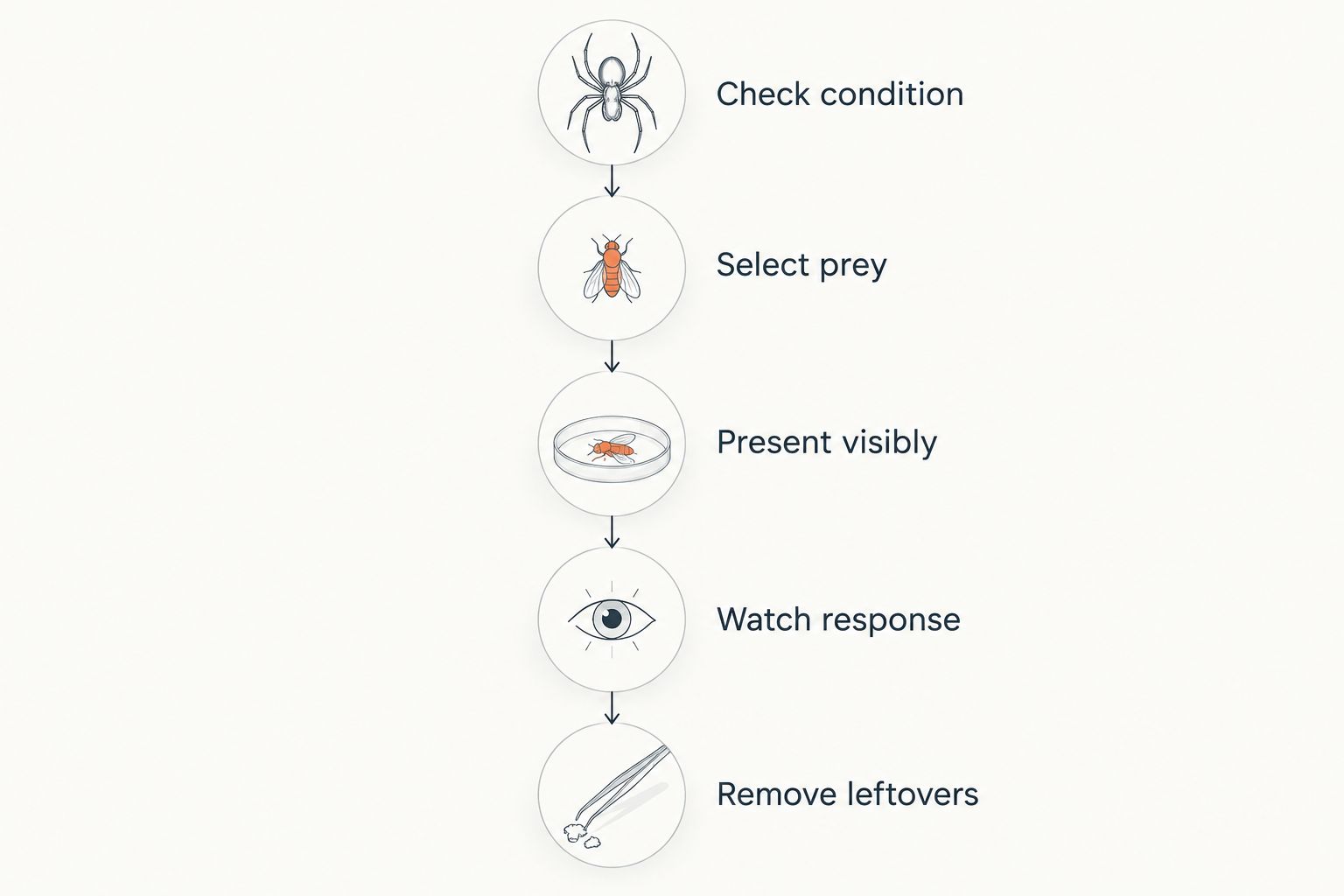
Use this sequence regardless of which feeder wins your 2026 comparison. Safe presentation and removal matter more than collecting every insect on the list.
- Check condition: Look for premolt behavior or a recent molt. Do not introduce live prey to a spider that is molting or still recovering.
- Select prey: Pick a manageable insect. Small spiderlings need much smaller offerings; appropriately sized pre-killed prey is an option for tiny spiders.
- Present visibly: Start with 1 insect per offering in an accessible area. Use a suitable dish for mealworms rather than dropping them onto substrate.
- Watch response: Leave the spider space to hunt. Do not push prey against its mouthparts or chase it around the enclosure.
- Remove leftovers: Retrieve refused live prey within 24 hours, sooner when premolt or vulnerability is evident. Remove feeding remains as well.
Keep feeder care separate from the tarantula's enclosure care. Use 2 separate containers when maintaining crickets and roaches, with housing suited to each insect rather than combining them into a mixed feeder bin. This is an organizational recommendation, not a required purchase list.
Maintain clean feeder housing and appropriate insect food and moisture. Feeder preparation does not justify leaving insects inside the tarantula's enclosure as a standing food supply.
How we ranked
This ranking prioritizes active prey, controlled presentation, retrieval, and practical feeder care. Banded crickets take the default slot for movement; dubia roaches win the ground-level handling slot; Acheta fits an existing routine; mealworms earn the supervised-dish slot.
The order does not claim laboratory-tested nutritional superiority or a feeding trial. Choose by the problem you need to solve, then confirm that the individual tarantula accepts the offering.
Which feeder insects should you choose?
Choose banded crickets if you want a default and can supervise feeding. Choose dubia roaches when jumping insects make transfer difficult, or mealworms when a feeding dish gives you better retrieval control. Keep Acheta if your existing routine works.
Buy quantities your collection can consume while the feeders remain a suitable size. For a single tarantula, feeder storage and growth deserve as much attention as the insect species. Bulk purchasing only fits when you can care for the batch.
FAQ
What's the best feeder insect for a tarantula in 2026?
Banded crickets are the default choice in this guide because their movement helps attract a feeding response. Choose a manageable size, supervise the offering, and remove refused prey.
Are dubia roaches better than crickets for tarantulas?
Dubia roaches are better for keepers who want less jumping during transfer, not universally better for every tarantula. Crickets provide more conspicuous activity, while roaches can hide beneath enclosure furnishings.
Can tarantulas eat mealworms?
Tarantulas can eat appropriately sized mealworms. Offer them in an accessible feeding dish and supervise feeding because loose larvae burrow into substrate.
Can I leave crickets in my tarantula's enclosure?
Do not leave refused crickets in the enclosure as a standing food supply. Remove uneaten live prey within 24 hours, and remove it promptly if the tarantula shows premolt signs.
Should I feed a tarantula during a molt?
Do not feed a tarantula during a molt. After molting, wait until the spider has hardened and its fangs are ready for feeding rather than following a universal waiting period.
What feeder insects should I give a tiny tarantula?
Give a tiny tarantula appropriately small prey; small pre-killed offerings are also an option for spiderlings. Remove ignored food and avoid oversized live insects.
Why won't my tarantula eat its feeder insects?
Premolt is one reason a tarantula refuses food, and refusal alone does not identify the cause. Remove the offering, assess the spider's condition and husbandry, and avoid repeatedly adding prey.
One last thing
Plan the exit before the entrance. Before offering any feeder, identify how you will retrieve it if the tarantula refuses. If removal requires dismantling the retreat or digging through substrate, change the presentation—not the spider's surroundings.